August 2026 · 4 min read · East Edge Concreting
Pool surround concrete: honed edges, exposed aggregate, coping and drainage
A pool surround is the one slab in the yard people stand on barefoot, wet, all summer. It has to look right and it has to grip, drain and stay flat against the pool shell. Here's how the options stack up.
Coping vs a monolithic slab
There are two ways to meet the edge of a pool. Coping is a separate row of pavers or stone laid on the pool beam, with the concrete slab behind it. A monolithic surround is one concrete pour that runs right to the water's edge — no separate coping, no grout lines.
Coping gives you a contrasting border and is easy to replace piece by piece. Monolithic gives the clean, seamless look and nothing to come loose. Most of the surrounds we pour now are monolithic, and the finish is either honed or exposed aggregate.
Honed seamless edge
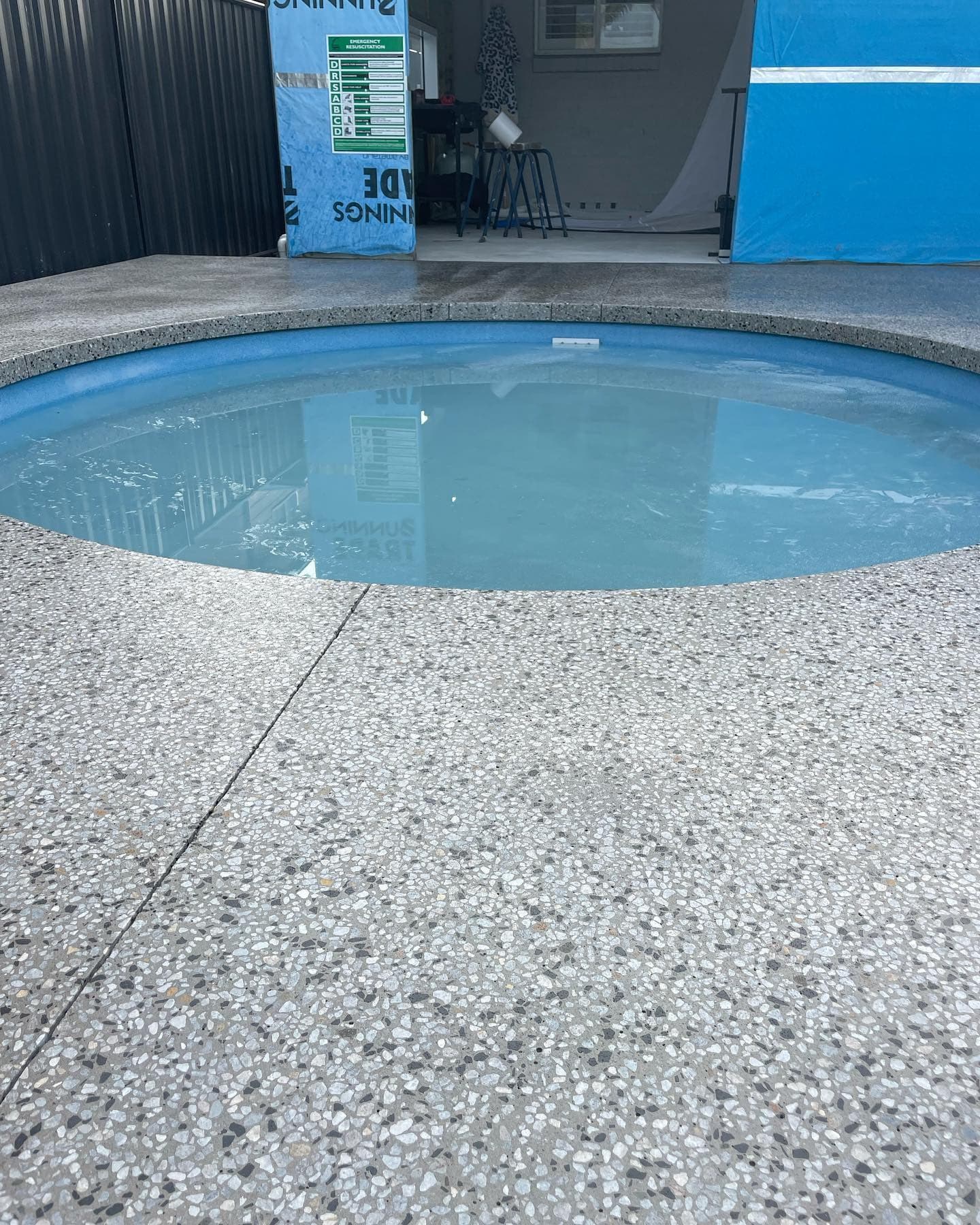
The slab is poured to the pool shell, cured, then ground back by a specialist to a smooth, matte surface that shows the stone. The edge is formed as a straight square drop or rounded over, and there is no visible join anywhere. On our circle pool the surround was honed after the pour and the edge was formed as a waterfall.
The trade-off is slip. A ground surface is smooth, so the sealer must carry an anti-slip additive, and the surround should be tested or specified to the wet-area slip class your certifier or pool builder asks for. We treat this as a standard step on honed pool work, not an extra.
Exposed aggregate
The same stone-and-oxide mixes we use on driveways — Cowra white, ocean floor, ivory — work around a pool. The washed texture grips bare feet in the wet without any additive, and it hides the sunscreen, leaf and wet-towel marks a smooth surface shows. The stone can be a little coarse for lying on a towel, so many people pair an exposed surround with a honed or timber sun-deck area.
Waterfall and bullnose edges
The edge profile is set by the formwork before the pour. A bullnose is a rounded edge; a waterfall edge is a thicker, rounded lip that drops over the pool wall so water and the edge appear to fall away together. Both are kinder on knees and hands than a square edge, and both need the slab and the pool beam to be tied together properly so the lip is supported.
Drainage, lids and working in with the pool builder
Water must fall away from the pool, never into it. As a rule of thumb the surround is set with a gentle fall of around 1 in 100 away from the water, and where the slab meets a house wall, fence or retaining wall a strip drain catches it before it pools. Splash-out is constant, so a surround with no fall is a surround with green edges by autumn.
Every pool has a skimmer box and often a second inspection point that has to be reachable through the slab. A plastic lid dropped into a honed or exposed surround looks like a plastic lid. We make our own stainless-steel skimmer and inspection lids in 150, 200, 246 and 276 mm sizes so the opening sits flush and reads as part of the finish rather than a hole in it.
The surround is poured after the pool shell is in and backfilled, usually once the pool has been water-tested. We set levels with the pool builder so the slab meets the beam at the right height, and leave the penetrations for skimmers, lights and glass-fence spigots. Tell us early if there's glass fencing; the spigot core-holes are set out before the pour.
Common questions
- What is the safest concrete finish around a pool?
- Exposed aggregate gives natural grip from the stone texture. Honed concrete can be just as safe when the sealer carries an anti-slip additive and the surface meets the wet-area slip class your certifier requires — it's standard on our honed pool work.
- What is a waterfall edge on a pool?
- A thicker, rounded concrete lip formed at the pool edge that drops over the pool wall, so the surround appears to fall away into the water. It's formed in the formwork before the pour, then honed or exposed with the rest of the slab.
- Do I need coping if I have a concrete pool surround?
- No. A monolithic surround runs the concrete straight to the water's edge with no separate coping. You'd choose coping only if you want a contrasting border or the look of a paver edge.