September 2026 · 4 min read · East Edge Concreting
How a concrete driveway is poured, start to finish
Most of a good driveway happens before the truck turns up. Here's the whole job in order, so you know what's going on in your front yard and why.
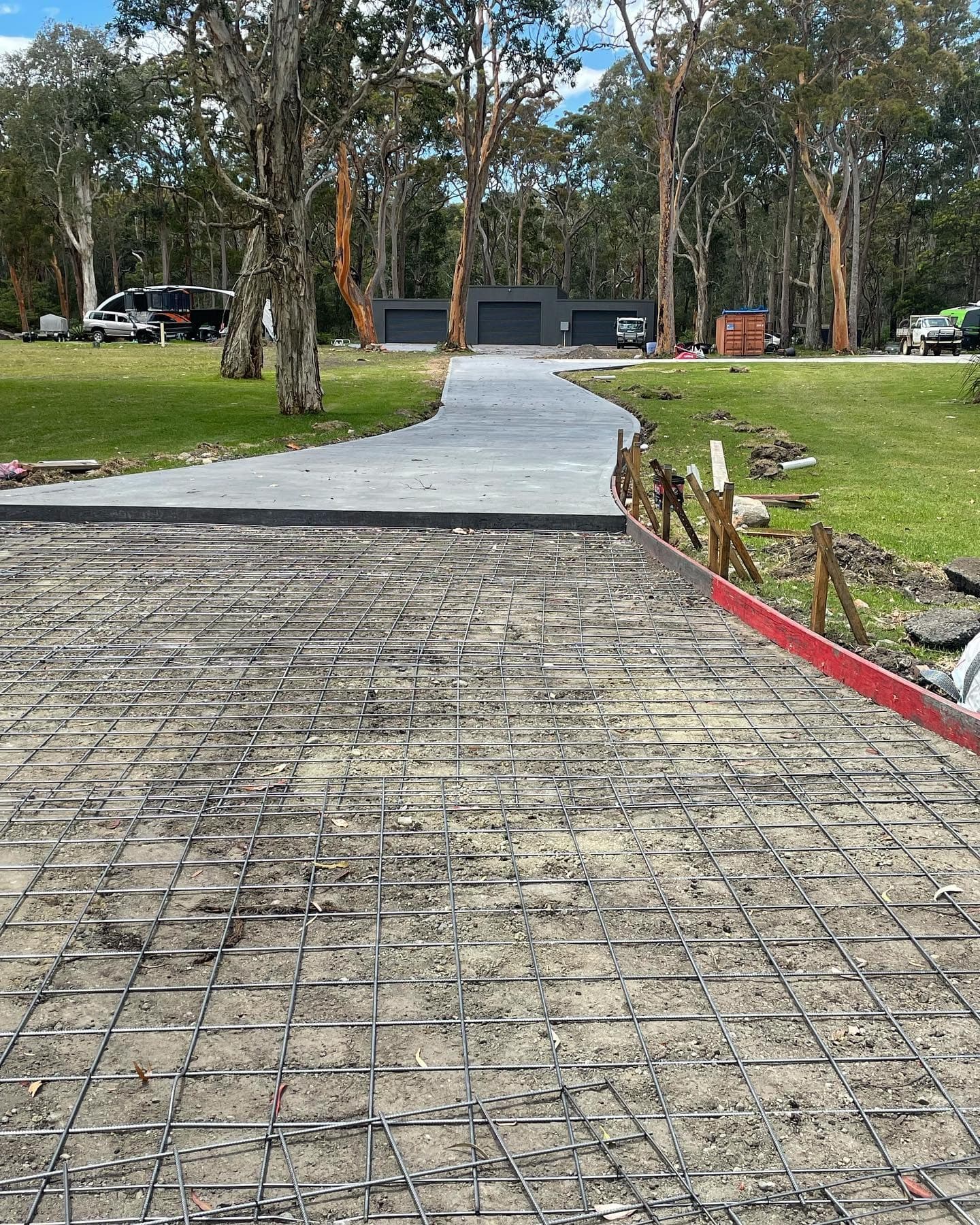
1. Site visit, measure and prep
We walk the block with you, measure the area, look at where water goes now and where it should go after, and check the crossover to the road and the entry to the garage. Slope, tight corners and truck access all change the plan. You get a measured quote from this visit, not a guess off a satellite photo.
Then the old driveway, turf or soft topsoil comes out. We dig to the depth of the slab plus its base, bring in road base and compact it so the concrete sits on a firm, even bed. Falls are set now — a driveway that ponds was built wrong at this step, not at the pour. Stormwater pits, drain grates and any conduits for lighting or gates go in too; a conduit under a slab is cheap before the pour and expensive after.
2. Formwork and mesh
Timber boards and pegs are set to the exact edge line and height of the slab. The forms decide the shape, the falls and the finished level against your garage, paths and the kerb, and they set how thick the slab will be — as a rule of thumb a residential driveway is poured around 100 mm thick. We check them with a level and a string line before anything else happens.
Steel mesh is then laid across the whole slab on bar chairs so it sits in the middle of the concrete, not on the ground. Mesh does not stop concrete cracking — concrete will always crack somewhere — it holds the two sides of a crack together so it stays hairline and the slab stays in one piece. Where the driveway takes heavy vehicles, we go up a mesh size.
3. The pour and screed
Concrete comes from the plant already mixed to the strength and, for decorative work, the stone and oxide we've ordered. It goes in by chute, wheelbarrow or pump depending on access. We spread it, work it into the corners and around the mesh, then screed it — dragging a straight edge across the forms to bring the surface to level and fall.
Timing runs the day. Once the truck tips, the mix is setting, and the crew works to that clock. A 200 m² driveway is a full crew, one continuous pour.
4. Finishing
What happens next depends on the finish you chose:
- Bull float — a wide float pushed across the surface to close it up and remove screed marks; every slab gets this
- Broom — a broom dragged in straight lines across the surface for grip (plain and coloured driveways)
- Trowel — a steel trowel for a smooth, dense surface (covered areas, or slabs that will be honed later)
- Exposing — surface retarder sprayed on, then the top paste washed off the next morning to reveal the stone
5. Joints, curing, sealing — and when you can use it
Control joints are cut or tooled into the slab in a grid so the cracking that will happen, happens in a straight line where we want it. Then the slab cures. Concrete gains strength by keeping its water, not by drying out, so we keep it damp or covered for the first days, especially in summer. Decorative finishes are sealed once the slab has dried through, typically about a week after the pour.
As a rule of thumb: foot traffic after 24 to 48 hours, cars after about 7 days, full design strength at 28 days. Keep trucks and skip bins off it for the first month. We'll give you the dates for your slab before we leave site.
Common questions
- How long does it take to pour a concrete driveway?
- Prep and formwork usually take a day or two, the pour itself is one day, and exposed finishes need a return visit the next morning to wash off. Sealing follows about a week later. Allow roughly two weeks from start to being able to drive on it.
- Does a concrete driveway need reinforcing mesh?
- Yes. Mesh holds the slab together at the hairline cracks all concrete develops, so they don't open up or step. It sits in the middle of the slab on bar chairs, and we increase the mesh size where the driveway carries heavier loads.
- Why do driveways have lines cut in them?
- Those are control joints. Concrete shrinks as it cures and will crack somewhere; the joints give it a straight, planned place to do it. On decorative work we plan the joint layout so it looks like part of the design.